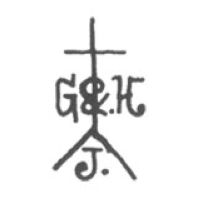
Image 0112-020-01-01
Used 1888 until mid-1891. The only ever used Küchler & Co. mark.
During an audit of historical sources in November 2025, I discovered discrepancies in the content of various Adressbuch der Keramindustrie (AdK) publications. These publications are usually highly reliable eyewitness accounts. One of these errors concerned Galluba & Hofmann, which had been mentioned in various editions of the AdK up until 1937 in one form or another before being labelled as "Betrieb liegt still" ("production has ceased"). The same quote was also published in Danckert (1992), whereas Roentgen merely stated "ca. 1937" in various publications. However, all these sources were incorrect, as the business in question actually shut down roughly two weeks before the US stock market crash on 1929-10-24. This fact, together with other newly acquired information, made me completely rewrite this entry in January 2026. All mark datings have been revised and corrected accordingly; the mark table below should therefore be the most precise around. Comments and questions are welcome.
Bernhard Küchler (full name Theodor Wilhelm Bernhard Küchler) was an independent merchant, drawing teacher and porcelain painter from Ilmenau. He was also temporarily active as a leading member of the Ilmenau Trade Association. On 1887-10-11, Küchler, together with financial backer Heinrich Hey, registered the business Keramisches Kunst-Institut Bernh. Küchler, located on Langewiesener Straße in Ilmenau. This legal entity then founded Porzellanfabrik und Keramisches Kunstinstitut Bernhard Küchler & Co., which was registered at the district court in Ilmenau on 1888-06-06; production itself started in August 1888. During that year, the company bought designs worth around 2,000 gold marks from Hugo Patzert, a designer and modeller who at first joined the company in 1889 but left the same year due to artistic differences.
In the following months, there were frequent changes to both business partners and registered company names. In May 1890, Heinrich Hey dropped out of the company. His place was taken by H. Eckhardt from Erfurt. However, his partnership ended in August of the same year. Matters only stabilised when Georg Hofmann, the proprietor of a dyeing factory from Königsee, and Gottlob Kummer from Ilmenau joined as partners late in August 1890. From then on, the factory and company were known as Bernhard Küchler & Co., a name which was officially registered on 1890-10-03.
Around this time, the factory employed 66 male and 13 female workers, with total wages reaching 51,000 Goldmark. Production focused on luxury items, fantasy items, figurines; the latter in combination with vases or jardinières and with rich floral decorations. Other items included apothecary jars, kitchenware, animals and small animal families. Figures and table settings up to 50 cm high and candelabras up to 75 cm high. Lobster bowls, censers, Easter eggs, wall decorations, cups, shoes, boots and baskets. All of these goods were exported to England, France, and North America.
Gottlob Kummer dropped out of the company again in February 1891, followed by founder Bernhard Küchler in July. On 1891-07-10 finally, Hugo Galluba joined as a partner. He had been a member of the board of the Ilmenauer Porzellanfabrik AG from 1881 to 1891. At the same time, founder Küchler left, leaving Georg Hofmann as the sole remaining partner. According to the partnership contract dated 1891-07-15, the company name was subsequently changed to Galluba & Hofmann.
These two dates are important, as some sources incorrectly state that the takeover took place in June. It is likely that they confused the month of the takeover with another event, as Georg Hofmann left the company on 1892-06-24. In his place, Gustav Adolf Klett from Ilmenau and Alfred Hermann Teufel from Werdau, the proprietors of the Schumann & Klett decoration studio in Ilmenau, joined as partners. Galluba & Hofmann soon started to specialise in decorative porcelain, porcelain dolls, and gift items. Their whole product range soon covered:
Behind the scenes, matters were still not settled. A new partnership contract had to be signed on 1892-06-02, as Georg Hofmann decided to leave the company. As was officially published on 1892-06-24, Hugo Galluba at the same time became co-owner of the Ilmenau-based decoration studio Schumann & Klett, whilst both of that business's proprietors, Gustav Adolf Klett and Alfred Hermann Teufel (both from Ilmenau), joined Galluba & Hofmann as partners. I will, of course, add a separate entry for Schumann & Klett at a later point, as their background and further development are matters in their own right.
Anyway, on 1896-03-13 (published 1896-03-18), Gustav Adolf Klett dropped out of Galluba & Hofmann again. In turn, Hugo Galluba and Alfred Hermann Teufel dropped out of Schumann & Klett, and businessman Emil Jäcklein and modeller Franz Gustav Albrecht each received joint commercial power of attorney at Galluba & Hofmann. These changes resulted in a new partnership contract between Hugo Galluba and Alfred Hermann Teufel on 1896-04-01, both of whom had long been awarded the honorary title of Kommerzienrat by Duke Wilhelm Ernst von Sachsen-Weimar-Eisenach.
Collectors will of course know Galluba & Hofmann as manufacturer of "snow babies", however these were only a small part of their product range. Other items or series included figures designed by the renowned modelers and sculptors Gustav Albrecht, Carl Brasch, R. Kopp, Ernst Leutheuser, Georg Mardersteig, Otto Poertzel, Hugo Patzert, Franz Reißmann or A. Rügheimer. Items designed by Henry van de Velde are also claimed to exist and some items were created by Siegismund Wernekinck, who also worked for Metzler & Ortloff. In the highly successful 1890s, company success was often linked with models created by Franz Gustav Albrecht, who in 1896 also received joint power of attorney at Galluba & Hofmann.
As we are just looking at the product range, we should also touch the subject of decorations, genres and styles. Decoration types included applied floral ornament, onglaze and underglaze decoration, various types of lustre decoration and glazing, as well as cobalt-blue decoration, while products with silk-fabric-style decoration were particularly successful during the early years. The company covered the Copenhagen, Delft, Meißen, Sevrés, Vienna, and Japanese genres and decorated in the Biedermeier, Empire, Rococo, and modern styles, as well as Art Nouveau.
It is claimed that the Grand Ducal family visited the factory several times. However, this seems to be an exaggeration, as if such a visit had taken place, it would have been mentioned in the local newspapers. Proof of this has yet to be found. Galluba & Hofmann's artistic achievements, on the other hand, did repeatedly receive recognition at major exhibitions. However, their actual impact can be debated, as their list of achievements is quite manageable:
The experience of Hugo Galluba undoubtedly contributed significantly to the factory's success, whose workforce had grown to over 500 workers six years later. Let's just make a mental note of the figure of 500 workers in 1897, which was mentioned in various publications and adverts. In an unreleased manuscript by Edmund Tröster, it is stated that Max Galluba, in direct correspondence with Tröster, said that the workforce at the time of the takeover in July 1891 had included a total of 75 workers. This figure rose to 207 in June 1894, reaching an impressive 655 by April 1899, which would cover the aforementioned 500 for 1897. The workforce remained above 500 until 1901, when it dropped to around 350 shortly before the outbreak of the First World War. Following the war's conclusion, only 150 workers remained.
While Max Galluba, alongside Alfred Hermann Teufel, was one of the later proprietors and should have known what he was talking about, we nowadays have to bear in mind that both the company presentation and an advert in the Adressbuch der Keramindustrie from 1906 claimed a workforce of "around 500" for that year, which conflicts with Galluba's "until 1901" statement. Such fluctuations in numbers were, however, completely normal and should never be considered definitive. This is not only due to the months-long lead time for printing such publications, but also because of the ever-changing nature of the subject matter.
Max Galluba also mentioned that, before the war, exports mainly went to England, North America and South America. He specified that, before and after the war, items were also exported to "all other countries, inside and outside Europe". That's another statement that should be taken with a pinch of salt, as even shipping a single thimble was considered a significant export operation worthy of mention back then. It's easy to forget that shipments to Egypt, for example, used to take two to four weeks, whereas nowadays we can ship goods there overnight.
One undisputable milestone in company history is the invention of a marble-like finish created with matte paint and glaze, the so-called "Marmorzellan", a compound word made up from "Marmor" (marble) and "Porzellan" (porcelain). Galluba & Hofmann filed a registration application at the Reichspatentamt in 1905, the process was then patented as Deutsches Reichspatent (commonly abbreviated "DRP" or "RP") №·179·562 in 1906. Due to the highly competitive relations between manufacturers and the fact that this registered term can only be found in adverts and such published after 1905, it should be safe to say that all claims in regard of mark use before that date, even if stated in many reference books and the website of descendant Stefan Galluba, are incorrect and should be corrected to 1905 as the protection of term and process started on the date of registration application.
Max Galluba, son of Hugo and Olga Galluba, joined the company as a business apprentice. He successfully completed his apprenticeship and became an employee on 1909-12-24. Hugo Galluba died on 1916-02-18, after which his wife Olga took over the running of the company with the support of her son Max, who received commercial power of attorney on 1916-07-05.
When the First World War broke out, the factory's main production was luxury porcelain for export. However, relying on this market segment alone proved fatal when the entire specialised product sector collapsed overnight. The situation did not improve after the war, and the following years were characterised by constant fluctuations in an effort to cope with the challenging domestic market conditions (see below). Olga Galluba died on 1925-02-17, with Max Galluba taking her position in the company. Business had still not improved greatly. Conversely, Hermann Merz, the authorised signatory and operations manager of the factory, had been married to the youngest daughter of Alfred Hermann Teufel. Following their divorce in 1926, he left the company to avoid conflict with his former father-in-law. Given all this, we can only imagine how Max Galluba must have felt when his business partner Alfred Hermann Teufel fell ill and had to drop out on 1928-05-08. Perhaps this was the moment when he finally lost hope.
In this context, we should address a fairly common misconception. Many Americans believe that the Great Depression was a single historic event that took place between 1929 and 1939 and was actually caused by the New York stock market crash. This is far from the truth: what would later become known as the Great Depression had begun much earlier; the stock market crash was merely a consequence of the shrinking economy - it did not cause it. We can find historical references to a shrinking economy as early as around 1921, when some companies, still geared towards supplying goods required during the First World War, had too many employees and expensive machinery with no real-world orders to justify their expenses. Layoffs followed and jobs became scarce, leading to increased poverty. Elsewhere, various countries, such as Germany, experienced hyperinflation, peaking in 1923. Therefore, the US and world economies were already in decline well before 1929.
From today's point of view, the demise of Galluba & Hofmann is easy to explain. For years, they had successfully served the export market, predominantly in North America. This meant that all designs and moulds were targeted at a single market and a very specific taste. During the First World War, however, the company was completely cut off from this market and had to reposition itself, which proved quite challenging. Not only was a large part of their mould archive rendered completely useless, but the domestic market in certain areas had never even heard of the company despite their many years of export-focused production. And, as there was a war on, nobody spent money on decorations.
Certainly, management issues and an inability to cope with a changing market contributed to their failure. However, the negative economic developments worldwide, especially after the war, should not be overlooked. Defeated Germany, already crippled by harsh reparations, quickly drifted into hyperinflation, peaking in 1923. The local economy was in ruins, and people once again had no interest in buying "Stehrümchen" (literally "little standing-arounds"), decorative items with no other function. The factory, which had operated a total of four large regular kilns as well as six indirect-fired kilns (Fürbringer-type muffle kilns from 1921 on) during its finest days, was forced to steadily decrease its workforce. Records show that just 140 people were still employed by Galluba & Hofmann when the factory closed in early October 1929.
In his correspondence with Edmund Tröster, Max Galluba described this as follows: "... Verluste enstehen wieder 1914 und 1915 und 1923, 1926, 1928 und 1929, sodass sich die Firma aus Gründen der Aussichtslosigkeit weiterer Rentabilität entschließt, den Betrieb stillzulegen, Maschinen, Utensilien, Waren und Vorräte nach und nach zu verkaufen, alle vorhandenen Verbindlichkeiten voll abzudecken und die Räumlichkeiten zu Wohn- und gewerblichen Zwecken zu vermieten ...", referring to the various years in which the factory incurred losses and the decision to cease operations in late August/early October 1929.
Alfred Hermann Teufel, who had never recovered, died on 1930-04-20. His place in the company was taken by his two daughters: Gertrud Reißner from Berlin and Käthe Merz from Ilmenau. While production ceased as planned, the company had continued in a different sector, renting out parts of the premises as living quarters or for business use. One such business was the Herzer, Reinhardt & Grübel decoration studio, which rented rooms in 1932.
The company name Galluba & Hofmann was finally erased from the trade records in 1941, twelve years after production had ceased.
Image 0112-020-01-01
Used 1888 until mid-1891. The only ever used Küchler & Co. mark.
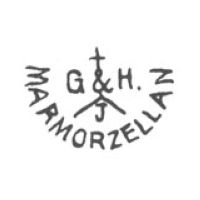
Image 0112-020-02-01
Possibly already used from mid-1891 onward, stamped. Finally registered at the RWZR under №·10·092 on 1895-10-10, deleted from the registry in 1916.
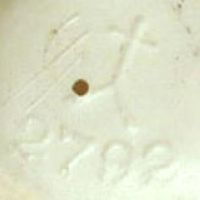
Image 0112-020-02-02
A near perfect example of the previously mentioned mark in blue.
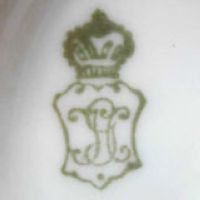
Image 0112-020-02-03
Registered at the RWZR under №·27·121 on 1897-10-18, deleted from the registry in 1916.
(Picture: Bobbie Dell'Acqua)
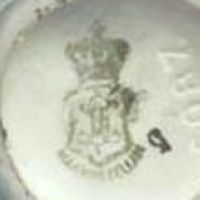
Image 0112-020-02-04
Used between approximately 1897 and 1916. Some impressed marks were accompanied by blue mark stamp.
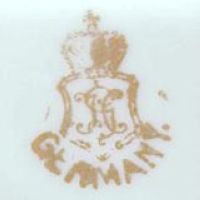
Image 0112-020-02-05
Used between 1905 and 1915, stamped on items with a marbled surface. Registered at the RWZR under №·79·179 on 1905-05-23, deleted from the registry in 1915
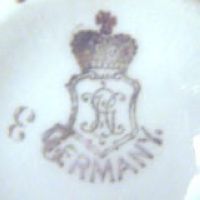
Image 0112-020-02-06
Used from 1905 onward, overglaze. Used only on items with "Marmorzellan" finish.
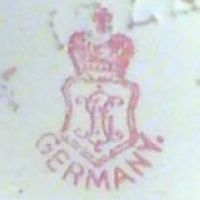
Image 0112-020-02-07
Used from 1905 onward, overglaze. Here applied on an item with an older blue mark.
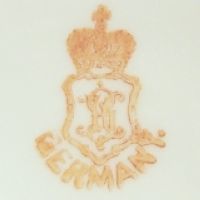
Image 0112-020-02-08
Used from 1905 until 1929. Registered at the RWZR under №·81·694 on 1905-09-20.
(Picture: Rachel, Pamela & Bruce)
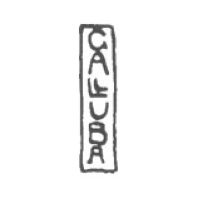
Image 0112-020-02-09
Please read the Comment(s) section remark on the dedicated export version. Shown here is a badly applied example in gold.
(Picture: Mike Walker)
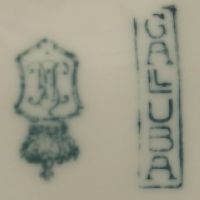
Image 0112-020-02-10
Example of another golden version carrying the addition "Germany".
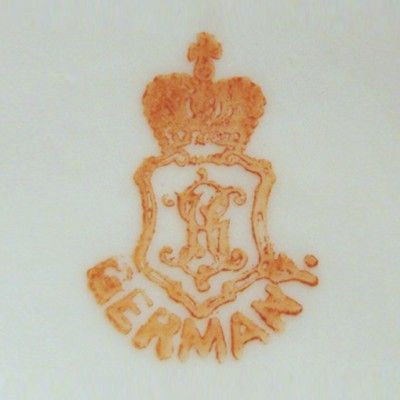
Image 0112-020-02-11
Example of an orange version carrying the addition "Germany".
(Picture: Carol Jones)
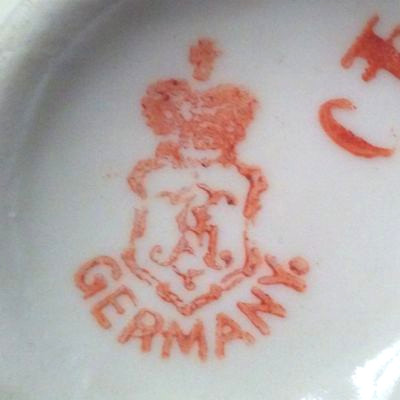
Image 0112-020-02-12
Example of a red version carrying the addition "Germany".
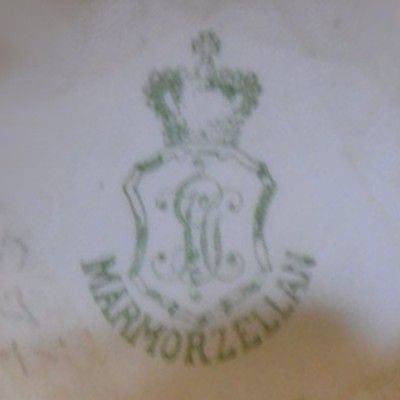
Image 0112-020-02-13
Used presumably from 1906/1907 onward; a combination of both "Marmorzellan" and the crowned shield mark.
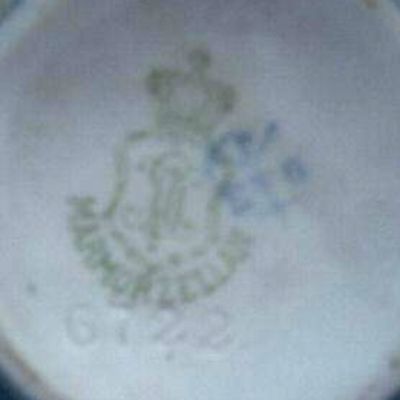
Image 0112-020-02-14
Regular crowned shield "Marmorzellan" version on older item with the stamped (1891-1916) mark.
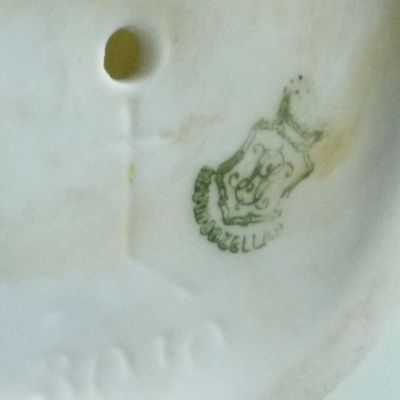
Image 0112-020-02-15
Regular crowned shield "Marmorzellan" version on older item with the impressed (1897-1916) mark.
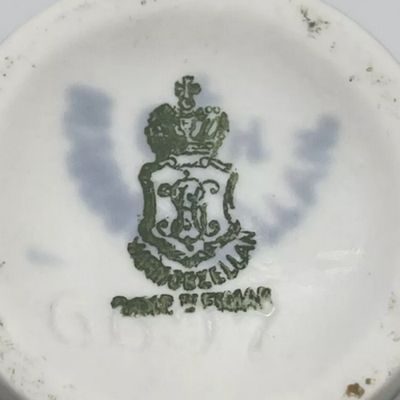
Image 0112-020-02-16
Regular crowned shield "Marmorzellan" version on older item with the curved "Marmorzellan" (1905+) mark.
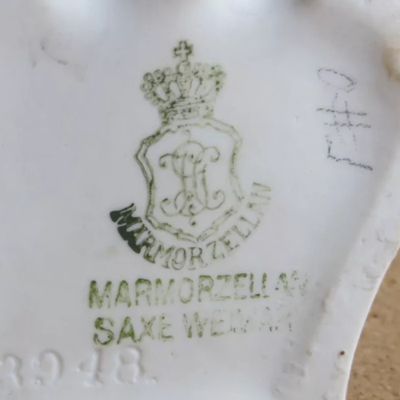
Image 0112-020-02-17
Rare mark version with dual "Marmorzellan" addition plus "Saxe Weimar".
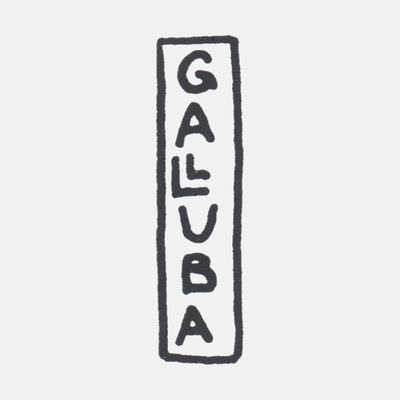
Image 0112-020-02-18
Used from 1911 onward. Registered at the RWZR under №·144·259 on 1911-05-19. Note how the two "L"s in "Galluba" are placed next to each other.
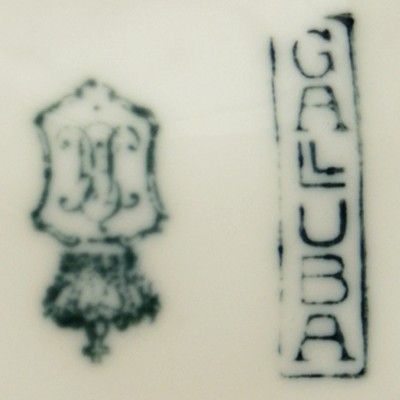
Image 0112-020-02-19
Used from 1911 onward. Perfect example of the previous mark together with the standard mark type (here found upside-down).