Image 0107-001-01-01
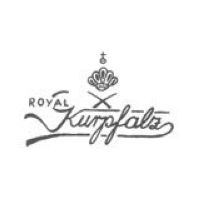
Used between 1951 and around 1972 on export items, crown over "Royal Kurpfalz".
The Winterling brothers were from the same family as Heinrich Winterling, who owned his own porcelain factory in Marktleuthen (Bavaria) under the name Heinrich Winterling GmbH & Co. KG. Contrary to popular belief, these two companies were not affiliated, even though they later used almost identical marks for marketing purposes.
The Gebrüder Winterling company was founded in Röslau, located in the heart of the Fichtelgebirge in the Upper Franconia region of Bavaria. In 1907, the seven Winterling brothers founded Gebrüder Winterling OHG with a newly built facility for porcelain production. As business went well from the outset, the facility was upgraded and expanded frequently. In 1917, the company took over the Porzellanfabrik Oscar Schaller & Co. in Schwarzenbach (Bavaria).
The upward trend was so promising that, in 1920, they bought and converted the textile factory in Kirchenlamitz (Bavaria), and, in 1929, they took over the Porzellanfabrik Eduard Haberländer company in Windischeschenbach (Upper Franconia, Bavaria). These extensions of the parent firm were all kept under the name Oscar Schaller & Co. Nachfolger until 1950, when the company became a corporation, with the Winterling family members being the main shareholders. All subsidiary companies were renamed Gebrüder Winterling AG, and the marks used up until then were changed.
In 1954, they opened their fifth facility in Bruchmühlbach, which produced porcelain and stoneware. However, from 1972 onwards, it specialised exclusively in Feinsteinzeug ("vitrified stoneware"), until it closed for economic reasons in 1995.
A few marks show an historic spelling form that includes an additional "t" in "pfalz", resulting in "Rheinpfaltz".
One of the marks also includes the addition HERO Porzellan, a company that was the so-called "factory outlet" of Blankenhain Porzellan. But why would a business like HERO add their mark to old, unrelated items?
Image 0107-001-01-01
Used between 1951 and around 1972 on export items, crown over "Royal Kurpfalz".
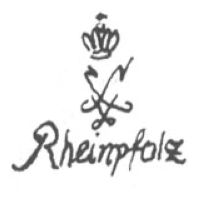
Image 0107-001-01-02
Used between 1951 and around 1972, "Rheinpfalz" above "Hartporzellan" and "Germany".
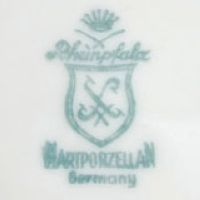
Image 0107-001-01-03
Used between 1951 and around 1962. Basically a crowned Schaller mark over "Rheinpfalz".
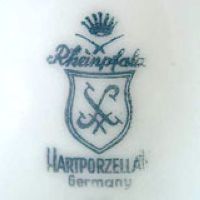
Image 0107-001-01-04
Used between 1951 and around 1962. Basically a crowned Schaller mark over "Rheinkrone".
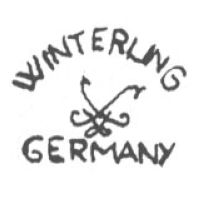
Image 0107-001-01-05
Used between 1951 and around 1962. Basically a crowned Schaller mark over "Rheingold" (note the HERO Porzellan addition!).
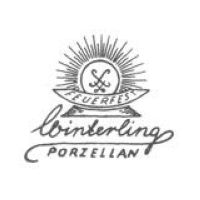
Image 0107-001-01-06
Used between 1962 and around 1972, Schaller mark above "feuerfest" above "Winterling" and "Porzellan".
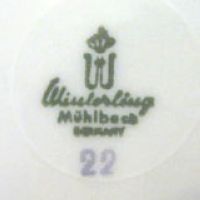
Image 0107-001-01-07
Used around 1965. "Winterling" above the old Schaller mark. Can be found either with or without "Germany".
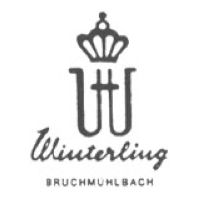
Image 0107-001-01-08
Used between 1967 and 1972. Rider on horseback above ":Kurpfalz Porzellan" and "Germany".
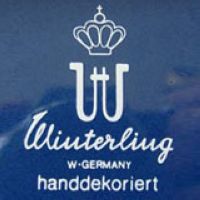
Image 0107-001-01-09
Used between 1969 and 1972. Crowned ":W" above "Bavaria".
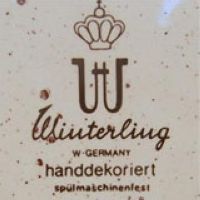
Image 0107-001-01-10
Used between 1969 and 1972. Crowned "W" above "Winterling" and "Mühlbach".
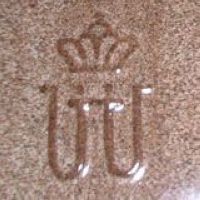
Image 0107-001-01-11
Used between 1972 and 1982. Crowned "W" above "Winterling", "Feinkeramik" and "Germany".
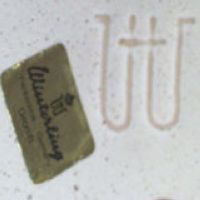
Image 0107-001-01-12
Used between 1972 and 1995. Crowned "W" above "Winterling" and "Bruchmühlbach".
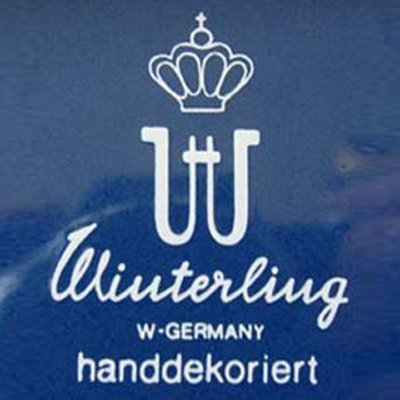
Image 0107-001-01-13
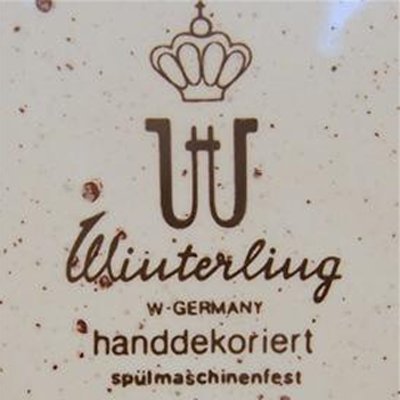
Used between 1982 and 1995. Crowned "W" above "Winterling", "W. Germany" and handdekoriert.
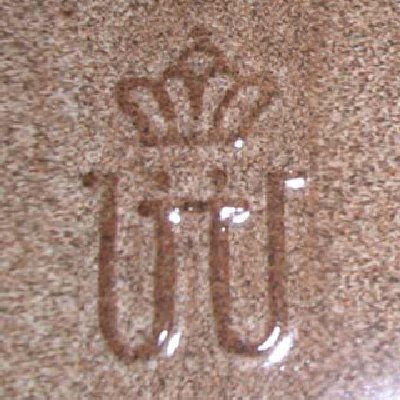
Image 0107-001-01-15
Used between 1982 and 1995, impressed version on a piece made of fine stoneware.
(Picture by Anja Wagemans)
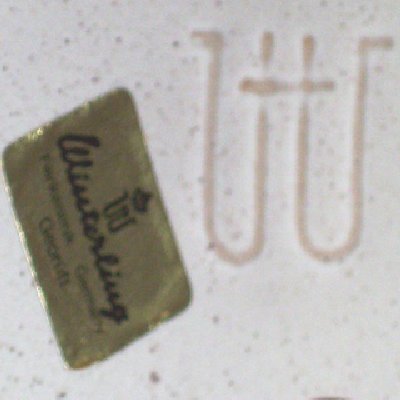
Image 0107-001-01-16
Used between 1982 and 1995, uncrowned impressed "W" and sticker reading "Winterling Feinkeramik Germany geprüft".