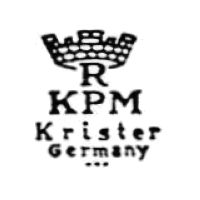
Image 0107-004-01-01
Used between 1952 and 1965, crisp mark without sub-dating.
(Picture: Uwe Kuttkat)
The original Krister Porzellan-Manufaktur was founded in 1831 by Carl Franz Krister in the town of Waldenburg in Silesia. In 1921, it was taken over by the Rosenthal group from Selb in Bavaria. Following the end of World War II, the Waldenburg area became part of Poland, resulting in the Rosenthal company losing the entire factory. To compensate for the loss of production capacity, the Rosenthal group soon started building a replacement facility in Landstuhl, Rhineland-Palatinate. As the legal successor, they continued to use the Krister mark with an "R" addition (indicated by the addition Nachfolger).
Some people believe that the "R" stood for the factory location (Rhineland-Palatinate), but as many others know, Rosenthal also introduced the "R" in marks after taking over companies such as Porzellanfabrik Thomas in Bavaria. Rosenthal has long confirmed that the "R" simply stands for Rosenthal. In 1965, plans were made to move the business to Marktredwitz in Bavaria, reactivating the former Porzellanfabrik Thomas facility, which had stood empty for five years after the Rosenthal group moved to Speichersdorf in Upper Franconia, Bavaria.
Note that 1965 is often quoted as the year of closure in that context, but the move itself actually occurred later. In fact, a few people have written to say that they were still employed there in 1966. The first person to get in touch with me was Sergio Calabri, who worked at Krister Porzellan-Manufaktur in Landstuhl in the cobalt firing section. He mentioned that Thomas and ABC branded items were also produced there between October 1965 and March 1966.
In 1971, the great Silesian enterprise was discontinued for organisational reasons, and the factory was closed. However, Rosenthal kept the Krister trademark and brand rights until 2004, when the Krister trademark registration was finally erased.
A cross-reference list of the sub-dating codes for this factory were, as far as I know, never published. Le Trianon, actually Le Trianon Joyeria, Habana, was Havana's most exclusive gift shop until the Cuban Revolution.
Image 0107-004-01-01
Used between 1952 and 1965, crisp mark without sub-dating.
(Picture: Uwe Kuttkat)
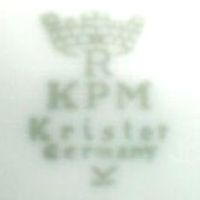
Image 0107-004-01-02
Used between 1952 and 1965, marking with ".." sub-dating and Le Trianon marking (Havanna, Cuba).
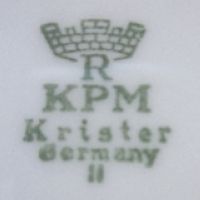
Image 0107-004-01-03
Used between 1952 and 1965, marking with "..." sub-dating.
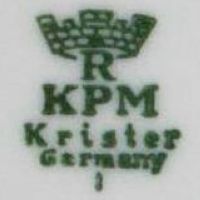
Image 0107-004-01-04
Used between 1952 and 1965, marking with "II" sub-dating.

Image 0107-004-01-05
Used between 1952 and 1965, a cover-up mark hiding an older mark (used on previously unfinished stock items).