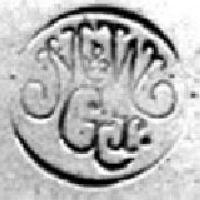
Image 0107-003-01-01
Used between around 1874 and 1921, encircled "M&W" above "Gr.".
Friedrich Wilhelm Merkelbach (*1840, †1896) already owned a pottery workshop - or, depending on the definition, a small ceramics factory - operating under the name F.W. Merkelbach II. when he was joined by the sculptor (Johann) Georg Peter Wick (*1837, †1914) in 1872 or 1874, depending on the source. From then on, the company was known as Steingut- und Steinzeugfabrik, Kunsttöpferei, Zinngießerei Merkelbach & Wick and mainly produced beer steins, ewers and vases. They applied their trademark, consisting of the fancy letters "M&W" above "Gr." enclosed in a circle, to their products. These letters stood for Merkelbach & Wick, Grenzhausen; it is common for the mark to be only partially impressed or indistinct.
From 1882/1883 onwards, they were one of the first factories in the Westerwald area to produce Elfenbeinsteinzeug ("Ivory-colored stoneware"), over half of which was exported to the USA; the factory also supplied semi-finished products to the ceramic factory of Hauber & Reuther between 1886 to 1897. In 1895, Ludwig Konrad Wick (Wick's son and, according to some sources, possibly Merkelbach's son-in-law) joined the factory and soon took over its management, before handing it over to his wife Emma in 1910/1911.
Around 1900, Jugendstil artists such as Peter Behrens and Henry van de Velde provided many outstanding designs. Other designers and artists who contributed to Merkelbach & Wick included Egon Braun, Ludwig Hohlwein, Charlotte Krause, Carl Moos, Albin Müller and Otto Obermeier. The large factory sticker applied on some items is quite rare but shows successful participation at four international exhibitions Wien (1873), Philadelphia (1876), Melbourne (1880), and Amsterdam (1883), as well as two national expositions: the 1876 "Kunst- und Kunstgewerbe-Ausstellung München" and the "Industrie- und Gewerbeausstellung Düsseldorf" in the year 1880.
In 1921/1922, the factory merged with the factory founded by Friedrich Wilhelm Merkelbach, Theodor Stadelmann und Julius Schröder as a milling and grinding stone factory in Grenzhausen around 1867; it is assumed that Konrad Wick's wife Emma was probably already a co-owner of this factory. The official new factory name was quite challenging: Steingutfabrik Wick Werke AG, Vereinigte Fabriken Merkelbach & Wick und Merkelbach, Stadelmann & Co.. This was often simply shortened to Steingutfabrik Wick Werke AG.
Image 0107-003-01-01
Used between around 1874 and 1921, encircled "M&W" above "Gr.".
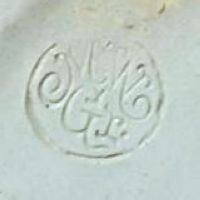
Image 0107-003-01-02
Used between around 1874 and 1921, another example.
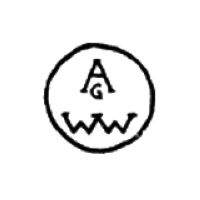
Image 0107-003-02-01
Used from 1921 onwards. Impressed; can also be found contained in a circle.
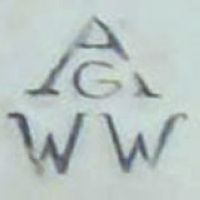
Image 0107-003-02-02
Used from 1921 onwards. Impressed and then filled with colour.
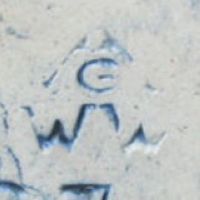
Image 0107-003-02-03
Used around 1955 with "Made in Western Germany".
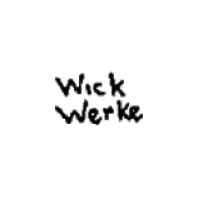
Image 0107-003-02-04
Also used from 1921 onwards, Wick Werke placed with a single leading initial.
(Picture: Heike R.)
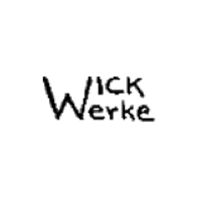
Image 0107-003-02-05
Another example of the previous mark, here on an item designed by Egon Braun.
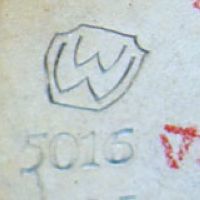
Image 0107-003-02-06
Used around 1955 with "Made in Western Germany".
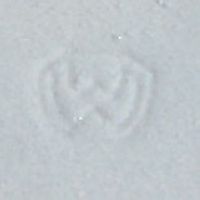
Image 0107-003-02-07
Used from 1960 onwards, impressed.
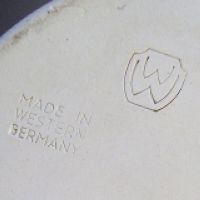
Image 0107-003-02-08
Used from 1960 onwards, another example.
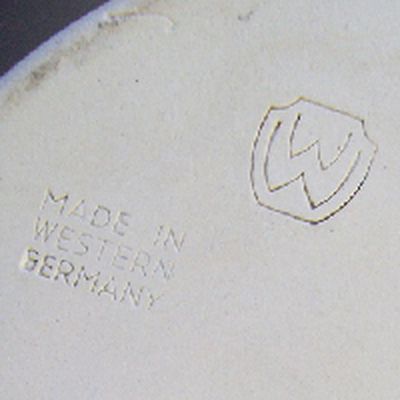
Image 0107-003-02-09
Used from 1960 onwards, here with "Made in Western Germany" addition.