Image 0107-047-01-01
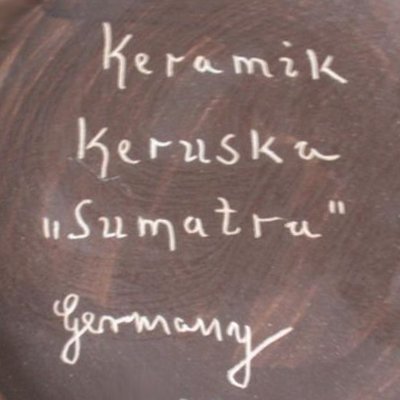
Used between 1965 and 1966. Hand-applied "KERAMIK KERUSKA" and "SUMATRA" above "GERMANY".
Established in 1964 as brand of the Simon Peter Gerz company, Keramik Keruska was initially geared towards "designer-made" ceramics, especially vases and candlesticks, which were intended to be sold exclusively via specialist retailers. The timing and presentation were perfect, with a massive marketing campaign and pleasing designs doing their best to convince potential buyers. Success was almost instantaneous, with supply soon exceeding demand. Yet just over a year later, Keramik Keruska had disappeared. Decades later, people were still wondering how this name could have appeared - and disappeared - so quickly. What puzzled people most was that nobody really knew where Keramik Keruska had come from in the first place. It is therefore no wonder that a lot of nonsense about its background exists, especially in the US.
First, let us consider the obvious. Advertisements from various publications clearly show that Keramik Keruska was located at "Töpferstraße 5-7" in Höhr-Grenzhausen, using the phone number "02624-245". Anyone can easily compare this information with the known address and phone number of the Simon Peter Gerz business. Many so-called "experts" in the US evidently failed to do so, resulting in claims that the Keramik Keruska "factory" was founded in the 1950s and was located in "Rheinburg", "Rheinberg", or "Rheinsberg" (depending on who copied whom).
Time to set the record straight: the entire Keramik Keruska brand was based on the work of Hanns Welling (*1924, †2008), who started studying painting and graphic arts just before the outbreak of the Second World War. He was forced to put these studies on hold until shortly after the war, finally completing them in 1951 by which time he had already gained a notable reputation. In 1952, he was appointed artistic director of the newly founded Keto-Keramik in Lantershofen. Between 1956 and 1958, he worked for Ruscha (Keramische Werke Rudolf Schardt) in Rheinbach. In late 1958, Jakob Schwaderlapp, the owner of Jasba Keramik in Baumbach, approached him and offered him the position of art director of the planned Jasba subsidiary, Ceramano, which was established in 1959. During his time at Ceramano, Welling not only designed all the ceramics, but was also responsible for conceptualising the entire product range, as well as designing the advertising and trade fair stands.
Welling worked for Ceramano until late 1961, when he left the company in search of new challenges. The company of Simon Peter Gerz approached him with a proposal for a new product line and brand, offering him complete creative freedom. He immediately started work on designing the company logo, advertisements, and the overall production concept for the new brand, Keramik Keruska. It should be mentioned here that Hanns Welling maintained this distinctive approach not only during his work for Oeslauer Porzellan Manufaktur W. Goebel (OPM) later on, but also when working as a freelance designer for various companies well into old age.
But dark clouds were already gathering on the horizon. Adverts in January 1966 were still promoting new products. However, even the last adverts, from August and October 1966, only featured the "Turmalin" series, the first ever series introduced early in 1965. While some people wondered what was going on, what actually happened to Keramik Keruska is no secret. Alongside the overwhelming success of Keramik Keruska, Gerz had also enjoyed great success with their own products, doubling their turnover between 1963 and 1966. However, this had pushed the factory in Höhr-Grenzhausen to its limits, with all the negative consequences: quality suffered, equipment broke and deadlines were missed. Ultimately, this proved too much for Gerz, forcing them to pull the plug on some projects in order to regain control.
At the same time, Hanns Welling was bored with his work for Gerz; he felt unsupported and the work had become sluggish. He therefore started working for the Oeslauer Porzellan Manufaktur W. Goebel (OPM) in 1965. That same year, he also designed the "Piroschka" soup set for Villeroy & Boch. Gerz, on the other hand, continued production of some of their most successful models after relocating the factory to Sessenbach. This time, they used their own name and the typical Gerz glazes. By mid-1967, the Keramik Keruska brand had long since drifted into oblivion.
One indicator of how things went between the two parties was the "Provence" tableware set, which Welling had designed for Keramik Keruska right after being contacted by Gerz. Unlike Welling's vases, the "Provence" set was only produced in very low numbers, which could not possibly match demand (most probably due to the aforementioned problems). Bear in mind that many court cases in the china and ceramics industry were initiated for far less, such as the use of non-exclusive transfer sheets or the basic similarity of mugs. However, Gerz let go completely, allowing Welling to slightly alter his "Provence" design and offer it to his new employer, Oeslauer Porzellan Manufaktur W. Goebel (OPM), which marketed it under the name "Country" from 1967 onwards. Unlike the meagre production effort invested by Gerz, Goebel went all in, providing a dedicated production line. Ultimately, they continued to sell this highly successful set for over 20 years.
We can only speculate as to why Gerz decided not to interfere. Allowing Welling to freely use a solid design elsewhere may have been their way of apologising for wasting his time. Alternatively, they may have feared a costly court dispute that would only have damaged their reputation. Confronting a personality like Welling would also have jeopardised all future work with designers, who would have feared being treated the same.
I wonder what could have been if Gerz had stuck to their word and backed Welling all the way? Dropping Keramik Keruska was probably one of the worst decisions the company ever made.
Image 0107-047-01-01
Used between 1965 and 1966. Hand-applied "KERAMIK KERUSKA" and "SUMATRA" above "GERMANY".
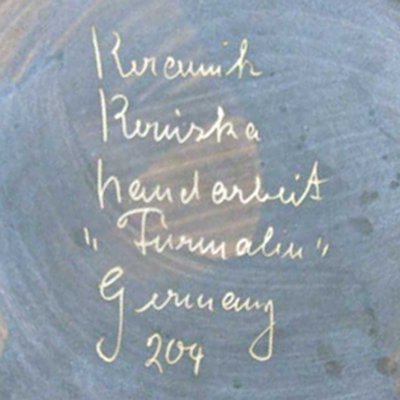
Image 0107-047-01-02
Used between 1965 and 1966. Hand-applied "KERAMIK KERUSKA", "HANDARBEIT" and "TURMALIN" above "GERMANY".
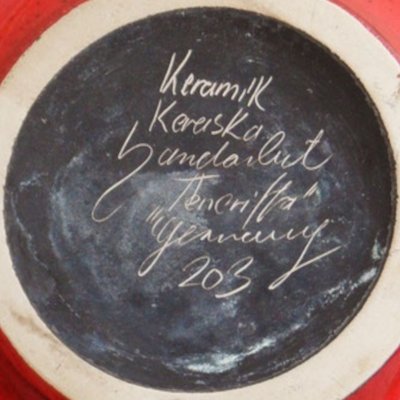
Image 0107-047-01-03
Used between 1965 and 1966. Hand-applied "KERAMIK KERUSKA", "HANDARBEIT" and "TENERIFFA" above "GERMANY".
(Picture by Ralf J. Schumann)
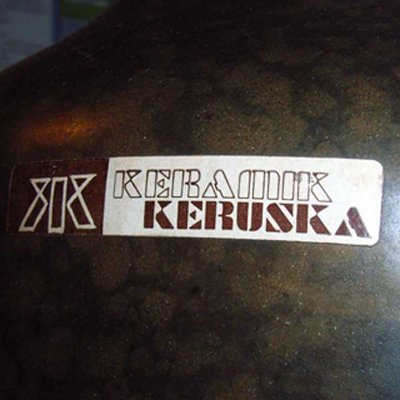
Image 0107-047-01-04
Used between 1965 and 1966, sticker with the company logo.
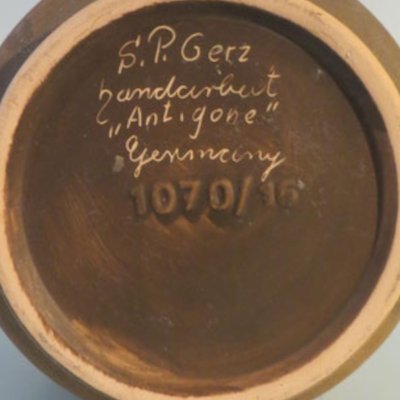
Image 0107-047-02-01
Example of a later Gerz product marking (1967+).
(Picture by Ralf J. Schumann)